

In the U.S. market in 2025, resin 3D printers consistently show significantly higher overall interest than FDM printers, with momentum strengthening toward the end of the year. In contrast, interest in FDM printers remains relatively stable with limited growth, indicating a gradual shift in user preference toward higher-precision printing technologies.
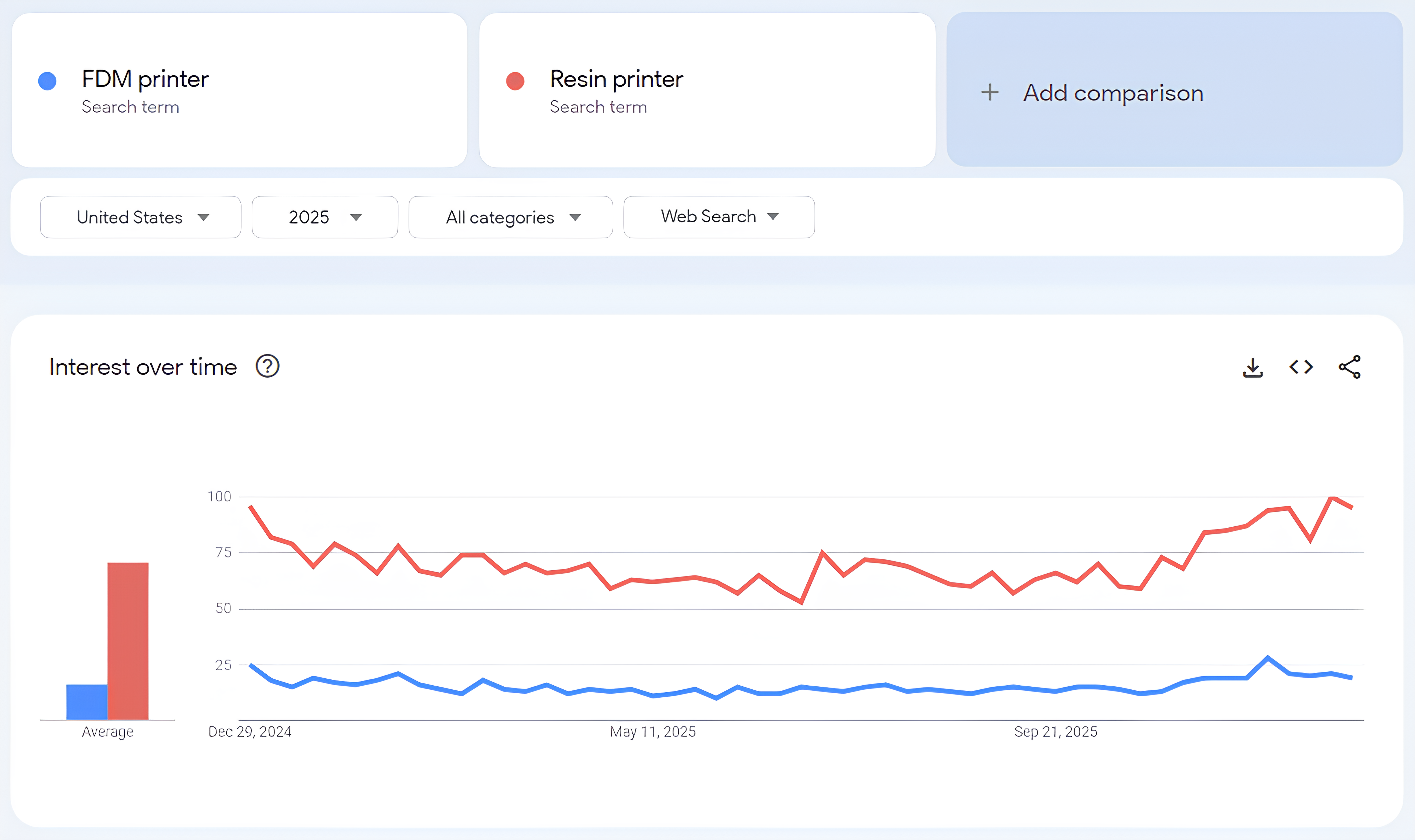
(Sourced from Google Trends)
How to Choose Between Resin Printer and FDM Printer?
In short, resin printers are ideal for applications that demand high precision, smooth surface finishes, and fine details—such as models, dental parts, and jewelry—especially when producing small, intricate objects. In contrast, FDM (fused deposition modeling) printers are better suited for low-cost, large-format, and functionally robust parts where fine detail is less critical.
If you’re thinking about getting or upgrading to a new resin printer, stick around.
Why "The Right Fit" Matters More Than "The Best" When Choosing a Resin 3D Printer ?
Honestly, a resin printer that fits your specific needs can help avoid wasted time, print failures, and frustration, while a "best" printer may have excessive features or fail to meet your expectations, lacking the necessary qualities such as resin compatibility, build volume, or ease of use. The key is to find a machine that excels at performing a particular task—whether its high-precision detail, functional strength, simple prototyping, or user experience—rather than chasing a multifunctional machine that lacks practicality.
What Do They Focus On More?
-
Hobbyists: Precision, Cost, Ease of Use
-
Professionals: Precision, Stability, Print Speed
-
Industrial: Precision, Stability, Maintainability, Production Efficiency
Printing beginners benefit from user-friendly workflows and printing ecosystems, while professionals may require advanced control features and larger build volumes. The so-called "best" may not be suitable for different groups. Although industrial-grade printers are the "best choice" for production environments, their high price and complex operation can be a deterrent for hobbyists. In this case, budget-friendly models are the "right fit" to meet their needs.
At Uniformation, we specialize in UV-curing 3D printing technology—not just to push boundaries, but to break them. We’re building a future-proof ecosystem where high-precision tools meet intuitive design, empowering makers, studios, and creative minds to bring their ideas to life with less friction and more control. From print to post-processing, every product we engineer is made to simplify complexity, accelerate innovation, and elevate the joy of making.

What Differentiates UniFormation in the Industry to Build a More User-centered Printing Ecosystem
UniFormation is the first brand in the industry to adopt under-vat resin heating technology, eliminating the need for manual resin heating during the printing process and significantly reducing print failure rates. Its printers emphasize stable and reliable mechanical design, combining large build volumes with high-resolution displays, while design optimizations help lower setup complexity. By refining key aspects of the user experience—including simplified calibration workflows, improved consistency for long-duration and batch printing, and enhanced compatibility with mainstream resins and slicing software—UniFormation enables users to reduce trial-and-error and achieve predictable, repeatable results. This design philosophy shifts the user experience away from constant tuning and troubleshooting toward a smoother, more confidence-driven workflow, making UniFormation printers especially well suited for advanced hobbyists, creators, and small studios that prioritize reliability, scalability, and long-term practicality.
Choose Your Perfect Match: The Ultimate Guide to UniFormation GK3 Series
Users Also Ask
Q: What‘s the benefit of the bed sitting sideways to drain as opposed to upside down?
A: When the build plate is upside-down to drain, resin can drip from a higher position back into the resin vat, which may cause splashing. This often requires manual cleaning of resin splatter inside the printer.
For hollow prints, an upside-down draining position can also cause resin to accumulate inside the model, making it difficult to drain completely.
With a sideways draining orientation, most of the resin can flow along the inner walls of the model and exit through gaps in the support structure, resulting in more thorough and cleaner drainage. It also helps reduce resin waste.